Tim Marlow is Chief Executive and Director of the Design Museum in London. Formerly Artistic Director of the Royal Academy of Arts and Director of Exhibitions at White Cube, Marlow has been involved in the contemporary art world for the past thirty years as a curator, writer and broadcaster. He was awarded an OBE in 2019.
May 2023. Edited from the Feeding Consciousness exhibition catalogue
Tim Marlow Most interviews in catalogues take place before a show has been installed. We have the luxury of doing a conversation at the end of the exhibition, so I want to know what you have learned from the interaction of the public with Feeding Consciousness.
Dominic Harris With the show being in London, I've been able to drop in quite often and eavesdrop on conversations. The bit that's been most satisfying for me has been to see the public response and engagement. Some of the stories I'm telling are all about optimism and beauty, but there's also definitely the underlying reminders of fragility and our ability to upset things in the world. But beauty is often seen as a superficial adjunct to the technological aspect of what's going on. Actually I do it because I love going to the studio. I genuinely love the creative process and I love the response it gives people.
Tim Marlow You mentioned beauty; it's almost a contentious word now. Is that more and more a device in your work — if not quite to entrap people, certainly to bring people in? Or do you think beauty in the natural world is something you feel passionately we should be celebrating and not be afraid of?
Dominic Harris As an artist, I have a choice to make, and I choose to make things which are beautiful. I want to be surrounded by beauty. Even within my pieces that have some slightly darker undertones, they are still created with an absolute eye for beauty. When I'm looking at nature, especially with the butterflies and the flowers, the fact is that nature's had millennia to perfect itself. I don't pretend to massively improve on that, but I want to extract the best from it and tell some stories.
Tim Marlow How do you respond to the idea that one of the things keeping young people away from the natural world is the digital media screen? And yet you're bringing them to the natural world through the screen.
Dominic Harris I use the screen because it allows me to create artworks that have a sense of time and, obviously very important to me, a sense of interaction. If you think of some of the greatest memorable moments of watching a David Attenborough documentary — that incredible, awe-inspiring scene of something happening — I'm trying to create artworks that have these moments wrapped into them, but they're there for you to discover. The screen is actually more of a canvas for me. And that canvas is my window into these worlds I am fabricating in order to tell these stories.
Tim Marlow There is sometimes a concern that the participation is trivial, that it's a kind of 'Wow, I can make butterflies fly!' Are you worried that there is a wow factor your viewer may not get beyond?
Dominic Harris I'm not worried. With the beauty comes the spectacle of the engagement. But there's also something below the surface of the pixels. In some of the pieces, you might be able to make a choice about the butterflies. For example, in Unseen I have used machine learning to tell the story of butterflies which nobody has ever seen before. The act of selecting is one of making conscious choice. You're choosing the colours you want that, over time, will impact the array. The first spectacle element is setting the butterflies into motion. But there is always this underlying story I'm trying to tell. There is this moment of connection when they begin to realise they are making a decision, and that it's not just a reactive piece; it is actually interactive.
Tim Marlow It is clear to me that Edmund Burke's notion of the sublime is evident in many of the pieces: the idea that we confront nature and we realise its fragility, but we also realise our capacity to damage it. But I think there's a kind of technological sublime in your work where it is almost miraculous, even to a digitally literate age, that as we touch the screen, these things change or morph or move. I wonder how much you take your technological facility for granted?
Dominic Harris In my studio, I've got twenty-odd people who help me create these pieces. So my studio is my ultimate playground and also a real production centre. I still get, on a really regular basis, those eureka or euphoria moments where I've been able to achieve a visual effect or model a particular bit of behaviour. These things still excite me almost daily. I walk in and I find something new. It's also why the artworks take forever to do — I can make changes and go, 'Well, actually it's not going to be the moon, it's now going to be a desert.' I can get caught up in that process of discovery. I'm able to make my own brush in order to create the brushstrokes. It is always an evolving toolkit.
Tim Marlow So often with technology, we have an end point and the route to that end point is kind of 'by the by'. I get the feeling that although digital technology is not seen as hands on, yours is quite a hands-on process. Do you learn through the process as you go along, or are you trying to realise something very clearly?
Dominic Harris It doesn't matter how clear my vision is at the start. It's actually the process of working through the concept that will sometimes lead me down a path that just keeps opening new doors. There always has to be an end point, when it has to physically end up on a wall. But that journey is a meandering journey, and that is the most incredible part of the process for me. The medium is very hands on. It's not just sitting at a keyboard coding. It is a process of painting, digitally painting or 3D sculpting. I like to 3D sculpt on the computer, but I also do it with clay. I make little maquettes, and then I can 3D scan them. I have a process that is remarkably physical for something that is digital in its nature.
Tim Marlow So the process is immersive for you. Just like the experience is immersive for us.
Dominic Harris Yes, my process being digital is both immersive and surprisingly messy. I can end up with tables full of bits of things I'm working on. It's not just happening on the computer.
Tim Marlow I'm struck with how every aspect of production, from the initial sketches to the realisation of imagery, to the coding, to the physical objects — you control it all in your studio. I could accuse you of being a control freak, with great respect, but there's no aspect of an idea being realised externally.
Dominic Harris I trained as an architect. I studied architecture at the Bartlett. I went all the way through to qualifying. I think there's something about that process — where from the sketch, to the drawing, to the model, to the physicality of building something that people can inhabit — you have to be controlled. The whole studio is made of a series of ateliers. Wood shops, electric shops, metal fabrication rooms. The workshops have grown up around me, but they're all extensions of what I want to be doing. I can find people who are better at those specific things than I'm capable of doing myself. The workshops have become their own R&D labs where I can test out ideas, backed up by people who share that same passion for execution.
Tim Marlow Do you now say 'I'm an artist'?
Dominic Harris The whole titles and labels thing is always a real danger zone. To me the art process is about the execution of a concept. I label myself as an artist, but I don't put myself forward as being a digital artist, an interactive artist, or an experiential artist. I'm just an artist.
Tim Marlow Where do you think your antecedents are? Do you feel there's a strong technological drive, or does classical mythology or surrealism have a similar impact?
Dominic Harris Those interests have become almost inseparable. I can no longer separate the technological aspect from the narrative or the aesthetic of it. It doesn't matter whether I'm looking at a piece that has AI and machine learning, or whether I'm looking at the Nixie tubes — a technology from the 1940s which I've been able to get made in a contemporary way. For me the technology just happens to be my palette of materials. None of these pieces are tech art; it's just art. All the pieces have to come together.
Tim Marlow I can see that your practice in the natural world is iterative. But is there an iterative aspect to the data that is amassed? Each day it effectively loses the trace of what happened yesterday.
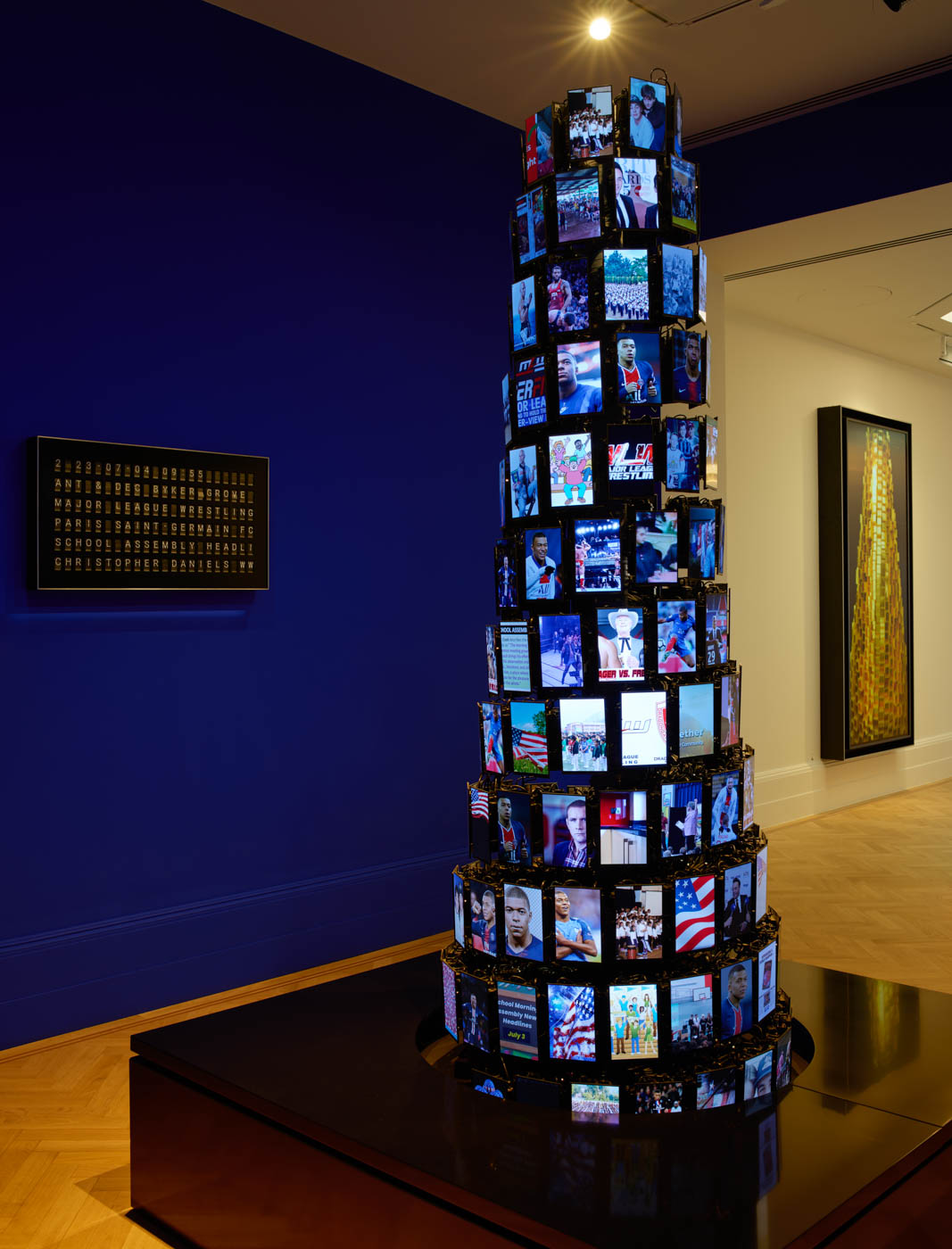
Dominic Harris These are real-time artworks. Not just real-time running on a computer but real-time in terms of the data. On the Feeding Consciousness tower I'm taking the trending topics of what people in the country are talking about, pulling images that represent those topics. Just the other week, there was a submarine that went missing looking for the Titanic and it was a trending topic, but the tower was responding with pictures of Leonardo DiCaprio and Kate Winslet because that was what was mapped to them. It took about twelve to eighteen hours for the tower to begin to show photographs of the lost submarine. There's something very interesting about that kind of real time — it reveals the lag of the search engines catching up.
Tim Marlow You mentioned that people cry when they come and look at art. That's quite a lot to get from artworks which are screen based.
Dominic Harris I think different elements trigger different things. A lot of it goes back to the butterfly. I initially picked them for what they symbolise to me in terms of fragility and grace and beauty and transience. Metamorphosis. It turns out a lot of people have very particular sentiments attached to butterflies — different colours or different types remind them of places they've been or some special time. When you start presenting huge arrays of butterflies, you're more likely to get to that kind of emotional state.
Tim Marlow What did you want to be when you were a child?
Dominic Harris I wanted to be an artist, but my parents talked me out of that! They said there is no money in art, so I should go and study architecture instead. Which I did. And then I went back towards art.
Dominic Harris The public domain is just an exciting place to be. It's unpredictable. Something like the flowers may end up in someone's home or they could end up as a huge installation in the lobby of a bank. I still get surprised by where the pieces end up being displayed. But the bit I would love to see more of is being in the public domain. The spectacle of the interaction can really bring about engagement.
I have at home two kids. The oldest one is twelve. For her entire life, she's grown up with the same flower and the same birds on the wall of our living room. It's such a part of the family that the shock horror when I had to remove one to put into an exhibition was almost devastating. There was no real public audience. It's something you are just living with and it becomes a familiarity. You get to know the character. You get to feel you understand what's going on, and you begin to have your own dreams about what it might be like to be there.
Dominic Harris If you take the World Stage artworks, you are presented with a large array of butterflies. You can touch them, interact with them, disrupt them. But if you step back, you realise it could be the American flag — and suddenly you've got this flag made out of butterflies. The story it's telling you is almost a childlike enjoyment of 'I can make everything move!' But what you're doing is actually a commentary about what was going through the world as we went through the pandemic. What seems to be a perfectly stable icon of a country can be disrupted temporarily. In my world, the butterflies will always rebuild, and the flag will always rebuild over time. But there are deep messages and symbolism occurring below what can apparently seem like quite a carefree act of movement. I quite like that duality.
Tim Marlow Serious play, I think.
Dominic Harris Yes. Serious play.
Tim Marlow is Chief Executive and Director of the Design Museum in London. Formerly Artistic Director of the Royal Academy of Arts and Director of Exhibitions at White Cube, Marlow has been involved in the contemporary art world for the past thirty years as a curator, writer and broadcaster. He was awarded an OBE in 2019.
Tim Marlow Most interviews in catalogues take place before a show has been installed. We have the luxury of doing a conversation at the end of the exhibition, so I want to know what you have learned from the interaction of the public with Feeding Consciousness.
Dominic Harris With the show being in London, I've been able to drop in quite often and eavesdrop on conversations. The bit that's been most satisfying for me has been to see the public response and engagement. Some of the stories I'm telling are all about optimism and beauty, but there's also definitely the underlying reminders of fragility and our ability to upset things in the world. But beauty is often seen as a superficial adjunct to the technological aspect of what's going on. Actually I do it because I love going to the studio. I genuinely love the creative process and I love the response it gives people.
Tim Marlow You mentioned beauty; it's almost a contentious word now. Is that more and more a device in your work — if not quite to entrap people, certainly to bring people in? Or do you think beauty in the natural world is something you feel passionately we should be celebrating and not be afraid of?
Dominic Harris As an artist, I have a choice to make, and I choose to make things which are beautiful. I want to be surrounded by beauty. Even within my pieces that have some slightly darker undertones, they are still created with an absolute eye for beauty. When I'm looking at nature, especially with the butterflies and the flowers, the fact is that nature's had millennia to perfect itself. I don't pretend to massively improve on that, but I want to extract the best from it and tell some stories.
Tim Marlow How do you respond to the idea that one of the things keeping young people away from the natural world is the digital media screen? And yet you're bringing them to the natural world through the screen.
Dominic Harris I use the screen because it allows me to create artworks that have a sense of time and, obviously very important to me, a sense of interaction. If you think of some of the greatest memorable moments of watching a David Attenborough documentary — that incredible, awe-inspiring scene of something happening — I'm trying to create artworks that have these moments wrapped into them, but they're there for you to discover. The screen is actually more of a canvas for me. And that canvas is my window into these worlds I am fabricating in order to tell these stories.
Tim Marlow There is sometimes a concern that the participation is trivial, that it's a kind of 'Wow, I can make butterflies fly!' Are you worried that there is a wow factor your viewer may not get beyond?
Dominic Harris I'm not worried. With the beauty comes the spectacle of the engagement. But there's also something below the surface of the pixels. In some of the pieces, you might be able to make a choice about the butterflies. For example, in Unseen I have used machine learning to tell the story of butterflies which nobody has ever seen before. The act of selecting is one of making conscious choice. You're choosing the colours you want that, over time, will impact the array. The first spectacle element is setting the butterflies into motion. But there is always this underlying story I'm trying to tell. There is this moment of connection when they begin to realise they are making a decision, and that it's not just a reactive piece; it is actually interactive.
Tim Marlow It is clear to me that Edmund Burke's notion of the sublime is evident in many of the pieces: the idea that we confront nature and we realise its fragility, but we also realise our capacity to damage it. But I think there's a kind of technological sublime in your work where it is almost miraculous, even to a digitally literate age, that as we touch the screen, these things change or morph or move. I wonder how much you take your technological facility for granted?
Dominic Harris In my studio, I've got twenty-odd people who help me create these pieces. So my studio is my ultimate playground and also a real production centre. I still get, on a really regular basis, those eureka or euphoria moments where I've been able to achieve a visual effect or model a particular bit of behaviour. These things still excite me almost daily. I walk in and I find something new. It's also why the artworks take forever to do — I can make changes and go, 'Well, actually it's not going to be the moon, it's now going to be a desert.' I can get caught up in that process of discovery. I'm able to make my own brush in order to create the brushstrokes. It is always an evolving toolkit.
Tim Marlow So often with technology, we have an end point and the route to that end point is kind of 'by the by'. I get the feeling that although digital technology is not seen as hands on, yours is quite a hands-on process. Do you learn through the process as you go along, or are you trying to realise something very clearly?
Dominic Harris It doesn't matter how clear my vision is at the start. It's actually the process of working through the concept that will sometimes lead me down a path that just keeps opening new doors. There always has to be an end point, when it has to physically end up on a wall. But that journey is a meandering journey, and that is the most incredible part of the process for me. The medium is very hands on. It's not just sitting at a keyboard coding. It is a process of painting, digitally painting or 3D sculpting. I like to 3D sculpt on the computer, but I also do it with clay. I make little maquettes, and then I can 3D scan them. I have a process that is remarkably physical for something that is digital in its nature.
Tim Marlow So the process is immersive for you. Just like the experience is immersive for us.
Dominic Harris Yes, my process being digital is both immersive and surprisingly messy. I can end up with tables full of bits of things I'm working on. It's not just happening on the computer.
Tim Marlow I'm struck with how every aspect of production, from the initial sketches to the realisation of imagery, to the coding, to the physical objects — you control it all in your studio. I could accuse you of being a control freak, with great respect, but there's no aspect of an idea being realised externally.
Dominic Harris I trained as an architect. I studied architecture at the Bartlett. I went all the way through to qualifying. I think there's something about that process — where from the sketch, to the drawing, to the model, to the physicality of building something that people can inhabit — you have to be controlled. The whole studio is made of a series of ateliers. Wood shops, electric shops, metal fabrication rooms. The workshops have grown up around me, but they're all extensions of what I want to be doing. I can find people who are better at those specific things than I'm capable of doing myself. The workshops have become their own R&D labs where I can test out ideas, backed up by people who share that same passion for execution.
Tim Marlow Do you now say 'I'm an artist'?
Dominic Harris The whole titles and labels thing is always a real danger zone. To me the art process is about the execution of a concept. I label myself as an artist, but I don't put myself forward as being a digital artist, an interactive artist, or an experiential artist. I'm just an artist.
Tim Marlow Where do you think your antecedents are? Do you feel there's a strong technological drive, or does classical mythology or surrealism have a similar impact?
Dominic Harris Those interests have become almost inseparable. I can no longer separate the technological aspect from the narrative or the aesthetic of it. It doesn't matter whether I'm looking at a piece that has AI and machine learning, or whether I'm looking at the Nixie tubes — a technology from the 1940s which I've been able to get made in a contemporary way. For me the technology just happens to be my palette of materials. None of these pieces are tech art; it's just art. All the pieces have to come together.
Tim Marlow I can see that your practice in the natural world is iterative. But is there an iterative aspect to the data that is amassed? Each day it effectively loses the trace of what happened yesterday.
Dominic Harris These are real-time artworks. Not just real-time running on a computer but real-time in terms of the data. On the Feeding Consciousness tower I'm taking the trending topics of what people in the country are talking about, pulling images that represent those topics. Just the other week, there was a submarine that went missing looking for the Titanic and it was a trending topic, but the tower was responding with pictures of Leonardo DiCaprio and Kate Winslet because that was what was mapped to them. It took about twelve to eighteen hours for the tower to begin to show photographs of the lost submarine. There's something very interesting about that kind of real time — it reveals the lag of the search engines catching up.
Tim Marlow You mentioned that people cry when they come and look at art. That's quite a lot to get from artworks which are screen based.
Dominic Harris I think different elements trigger different things. A lot of it goes back to the butterfly. I initially picked them for what they symbolise to me in terms of fragility and grace and beauty and transience. Metamorphosis. It turns out a lot of people have very particular sentiments attached to butterflies — different colours or different types remind them of places they've been or some special time. When you start presenting huge arrays of butterflies, you're more likely to get to that kind of emotional state.
Tim Marlow What did you want to be when you were a child?
Dominic Harris I wanted to be an artist, but my parents talked me out of that! They said there is no money in art, so I should go and study architecture instead. Which I did. And then I went back towards art.
Dominic Harris The public domain is just an exciting place to be. It's unpredictable. Something like the flowers may end up in someone's home or they could end up as a huge installation in the lobby of a bank. I still get surprised by where the pieces end up being displayed. But the bit I would love to see more of is being in the public domain. The spectacle of the interaction can really bring about engagement.
I have at home two kids. The oldest one is twelve. For her entire life, she's grown up with the same flower and the same birds on the wall of our living room. It's such a part of the family that the shock horror when I had to remove one to put into an exhibition was almost devastating. There was no real public audience. It's something you are just living with and it becomes a familiarity. You get to know the character. You get to feel you understand what's going on, and you begin to have your own dreams about what it might be like to be there.
Dominic Harris If you take the World Stage artworks, you are presented with a large array of butterflies. You can touch them, interact with them, disrupt them. But if you step back, you realise it could be the American flag — and suddenly you've got this flag made out of butterflies. The story it's telling you is almost a childlike enjoyment of 'I can make everything move!' But what you're doing is actually a commentary about what was going through the world as we went through the pandemic. What seems to be a perfectly stable icon of a country can be disrupted temporarily. In my world, the butterflies will always rebuild, and the flag will always rebuild over time. But there are deep messages and symbolism occurring below what can apparently seem like quite a carefree act of movement. I quite like that duality.
Tim Marlow Serious play, I think.
Dominic Harris Yes. Serious play.